For a long time, the product development lifecycle was a rigid, linear, waterfall march. We spent weeks on discovery, followed by heavy documentation, then design, and finally, development.
Then came Agile.
With Agile, we put (user) value first. We started to inspect and adapt, shortened feedback loops, started to work in smarter increments, and committed to continuous learning. As PMs, we were the glue – managing product backlogs, facilitating rituals, attending (a lot of) meetings, strategizing, and generally translating ‘business’ into ‘tech’.
Then came AI.
Things are still evolving (fast), but we can say for sure that it is no longer enough to ‘just’ write documentation and wait for engineering resources. At more and more companies (like Google and Duolingo), a vibe coding mindset is becoming the standard: showing what you mean by building a prototype is replacing the old ‘writing-first’ culture.
‘Mexican Standoff’ and the future of product roles
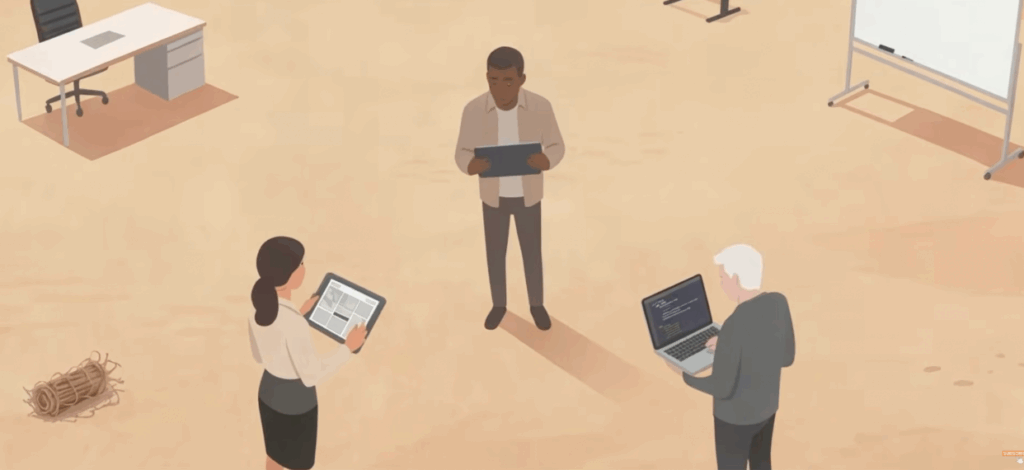
The borders between the traditional roles of product managers, designers, and developers are becoming fuzzy. We are seeing a convergence where they are merging. We are evolving into designers who develop and orchestrate and strategize, developers who design and orchestrate and strategize, and PMs who design and develop. Each of the three thinks they can do others’ jobs. What Marc Andreessen called a ‘Mexican Standoff’ on Lenny’s Podcast.
While these distinct roles will likely still exist (for some time), in the future, we might end up with one role, one builder, with design, product or development as flavor.
And then we have officially entered the era of AI-powered builders.
The current realities and practicalities of the PM role
Maybe we’re not there yet, in the AI-powered builders era, but as a product manager, if you want to keep up, you need to put your workflow on steroids. Here’s how I do it.
Interested in Product Discovery with AI? Have a look at my talk: The Great AI Reversal: End of the PRD and the New Rules of Discovery @ UXDX Community, or have a peek at the slide deck.
6 use cases that work for me today
Automated note-taking, analysis, and summarization
AI is great for capturing, analysing and summarizing meeting notes (for example, Gemini with Google Meet). Beyond having transcripts + summaries at event level, Gemini works with Google Drive so you can easily search across meetings/files (e.g. “What did we decide about the profile image filter feature?”) or ask it about patterns (e.g. “What is the most usual concern for stakeholders A and B?”).
User simulation
You can easily stress-test ideas with AI, even before you talk with the real users and stakeholders. For instance, I was playing with saving .md files for our user personas and asked Claude (Code) to discuss a feature from each persona’s standpoint. This is NOT a replacement for actual discussions with your actual users and stakeholders, but it’s great for brainstorming and stress-testing.
Drafting/writing artefacts
PRDs; ADRs; JTBDs; themes, epics, user stories & acceptance criteria; release notes & changelogs; “microcopy”…
I am responsible for the final outcome – but honestly speaking, AI does the most writing. Claude can even create pages for me and write directly in Notion or Linear.
Working with PM tools
The beauty of agentic AI is that it carries out your intent using multiple steps and tools. Thanks to MCP – which the most if not all leading PM tools support – you can now talk with your tools. You can describe in natural language what you want to achieve, and the AI takes care of it. In my case, Claude works seamlessly with Linear and Notion, and I use it to both generate new artefacts and analyze and summarize existing content across different projects and contexts.
Landscaping / Research
“List features that companies A, B, C and D offer in the enterprise plan, and see where we overlap or not.” This is could take a few hours manually, but with AI it’s done in minutes at a very decent level.
Simple chatting
Sounds basic, but I also love to bounce ideas and write using the good old chat interface, mostly Gemini.
2 use cases I’m thinking about trying
Gathering data at scale
Could/should we let chat agents ask questions and discuss with the stakeholders with the goal of exploring (e.g. through Intercom).
Rapid prototyping
Besides a number of smaller side projects, I haven’t actually used vibe coding (prototypes) in my work as a PM (yet).
3 things to remember
Goes without saying, but:
You are the driver – you need to be responsible and own the final result. Current AI technology is great, and it will only get better with time, but it’s still prone to errors. People are also prone to errors, so I’m not saying you shouldn’t use AI, but try to verify and be careful according to priority and common sense (high risk, high priority = more double-checking).
There’s a value in the process itself. Many times, I think things through by writing. Sometimes it’s good to do things manually as a learning.
AI shouldn’t replace your critical thinking, problem framing etc. It should empower you to do more of it and the things that matter.
* Featured image created using GenAI and Canva